Étoile Filante IV 5.11c, 300m, South face of Asgard peak, Valhallas
David Lussier on Sep 15, 2011
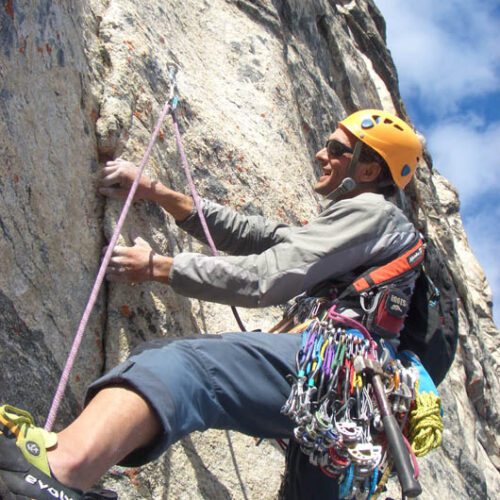
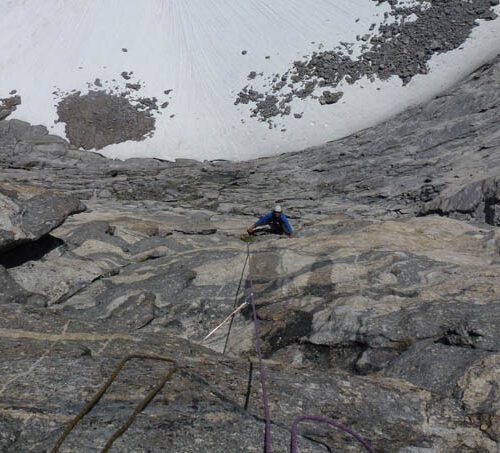
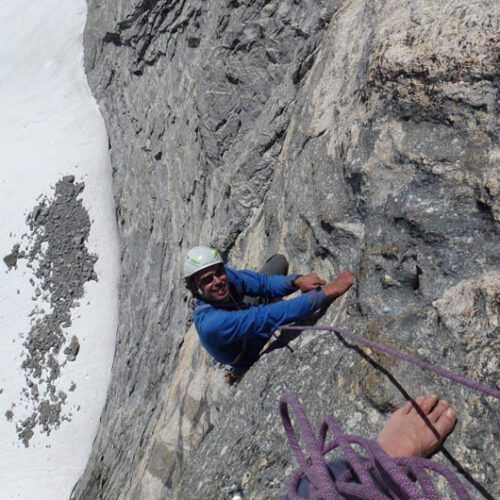
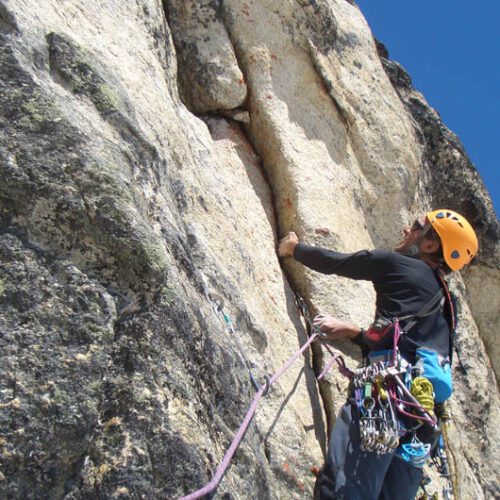
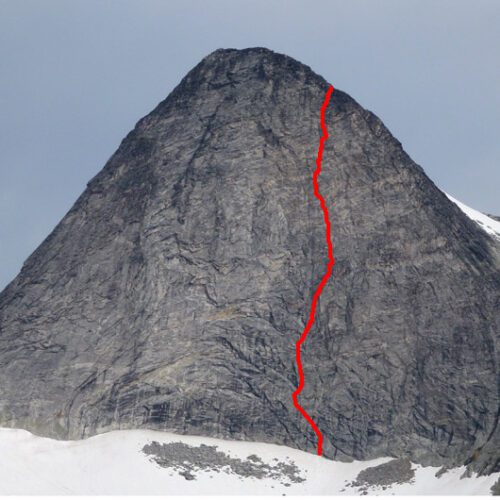
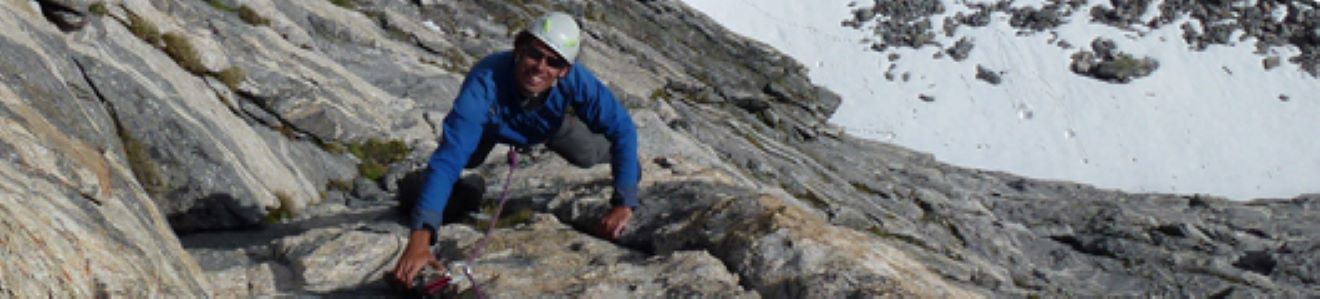
Cam Shute and I returned to beautiful Mulvey Basin in Valhalla Provincial Park this past July and completed a new route on the South Face of Asgard Peak. Our cumulative efforts spread over two years along with an evolving vision resulted in a new independent line on the right side of the South Face. Click here for more info.
Étoile Filante IV 5.11c, 300m, South Face of Asgard Peak
F.A. David Lussier and Cam Shute, July 2011
The story behind the line
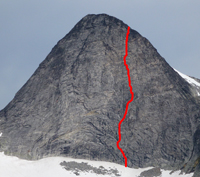

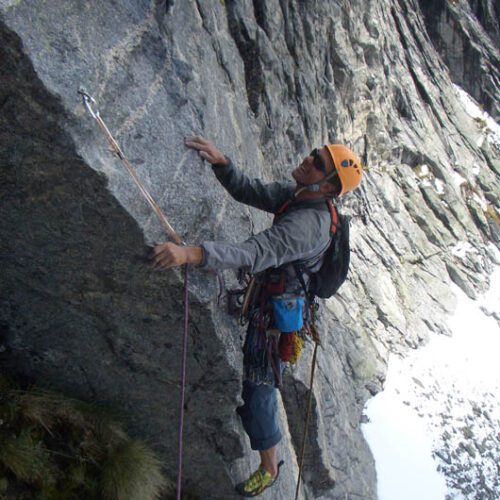
The South Face of Asgard has attracted climbers for almost 40 years. The first route up this sheer featured wall, the “Center Route IV 5.8”, was climbed by Valhalla pioneers Peter Koedt, Peter Rowat along with Greg Shannon in 1973. Peter Koedt returned to Asgard a few years later, in 1975, to climb the “Left-Center Route IV 5.8” with James Hamelin and Jara Popelkova. These two traditional routes follow the most dominant features on the face and continue to challenge climbers to this day. They offer varied climbing (cracks, flakes & chicken heads) with interesting route finding along with sustain difficulty. Up until now these where the only established routes on the south face.
The vision of a new route on this face has been shared by many over the years. From various trips in Mulvey Basin over the years, I had always been interested by the complexity of the upper right side of the wall. It wasn’t until July 2010 that Cam Shute and I ventured into Mulvey with the intention of exploring that potential. Due to the disconnected nature of the crack systems, some blank looking section and the steepness of the wall, we decided to bring a hammer drill along with some bolts. This exploratory trip, culminating with a high point somewhere half way up the steep upper right wall, revealed potential for a great line on featured but compact rock. We were already planing our return.
Our vision evolved some more before we eeturned in July 2011. With a greater knowledge about the nature of the rock and the various line options we decided to bring the drill back. We were considering bolting an interesting looking blank arête to help straighten the lower part of the route and also using bolts for adequate protection on the upper compact wall. If the route turned out to be good quality, we also contemplated bolting the belays to facilitate rappelling. All of this would of course be done while climbing from the bottom. We were very excited about possibly finishing the route.
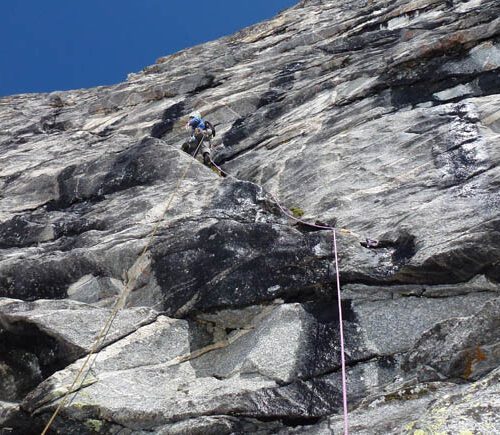
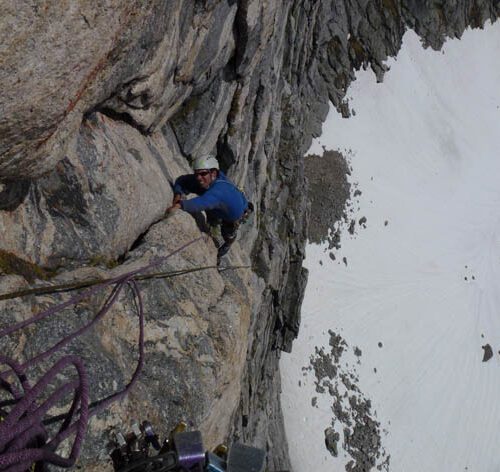
The end result was greater than anticipated. The vision, our skills and luck combined with our commitment allowed us to complete a new modern mix/trad route up the beautiful right side of the South Face. A lot of the visioning and actual route location decisions beautifully came together over the 4 days Cam and I were working on the wall. The climbing on the direct arête lower down (pitch 2) was challenging and quality while providing a more direct line. The intricacy of the steep upper wall revealed themselves after a few days of committing route finding on the sharp end. In someways the route revealed itself and we basically connected the dots. Completing it was very satisfying but putting the puzzle together was the best part. We really hope that others get to enjoy this quality and modern alpine rock route, the topo and route description are just below.
Thanks again Cam for such a fun adventure, it was a pleasure new routing with you!
Name background
“Étoile Filante” is french for “Shooting Star”. The name choice comes as a tribute to Valhalla pioneer Peter Koedt who sadly passed away in the Fall of 2010. The inspiration for the name comes from the song “Étoile Filante” by “Les Cowboy Fringant”. This beautiful song compares each human’s life existence, turmoils, successes and absurdity to the passage of a shooting star. We feel Peter was a visionary climber who put lots of skills and creativity amongst the Valhalla peaks. We will remember his passage and contribution as a brilliant shooting star.
Access & Description
Étoile Filante IV 5.11c, 300m, South face of Asgard peak, Valhallas
Access
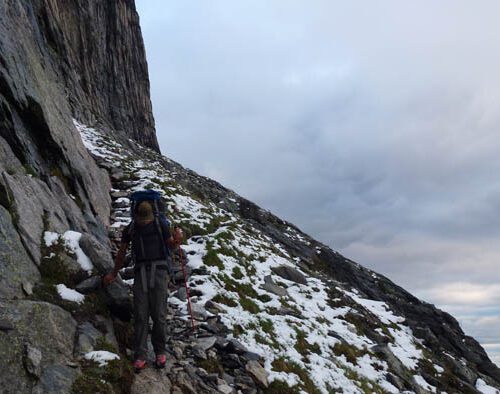
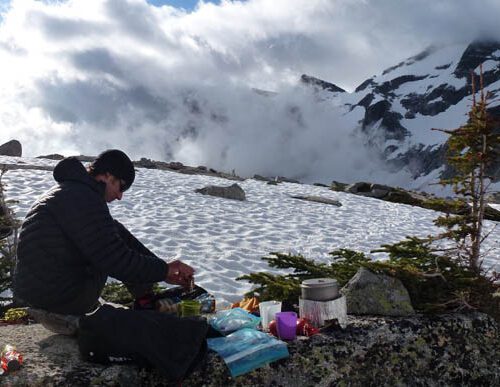
Asgard Peak is located in Valhalla Provincial Park in Southeastern British Columbia. It is roughly 15km West of Slocan Lake near the headwaters of Mulvey Creek. To access the South Face of Asgard, climbers must start by following the regular access trail to the well known Gimli Peak from the Bannock Creek forest service road. From the regular campsite at the base of the South Ridge of Gimli, follow a trail along the west face of Gimli to a col between Gimli and Nisleheim peak (750m elevation gain over 5km). The South Face of Asgard can be seen directly across Mulvey basin from the col. The best camping
location for this route is about 300 vertical meters below the north side of Gimli col near one of the upper Mulvey lakes.
To get into Mulvey Basin from the col, start by locating an exposed but very handy left trending diagonal ledge on the steep north side of the col which begins near the middle of the broad col (cairn). Carefully scramble down the initial moves then traverse more easily West to the top of a steep snow/ice slope. Descend this slope; depending on the conditions crampons and ice axe can be very useful. Continue descending into Mulvey basin on snow (early season) or rock slabs (late season). Many beautiful alpine meadow for camping with good water options exist near the upper Mulvey Lakes (300m elevation loss over 1km). To access the South Face from Mulvey Lakes, ascend moderately steep slopes up and left of some rock slabs in a Westerly direction and eventually gentle slopes in a Northwesterly direction (300m elevation gain over 1.5 km).
Route Description
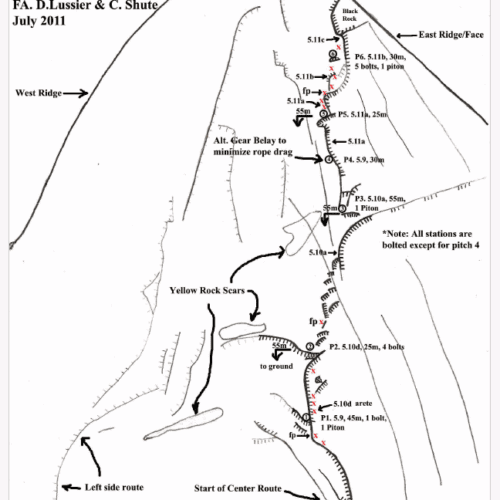
The route starts about 15m right of the 1st pitch on the original “Center Route”. It begins near the base of a left slanting crack/ramp about two thirds of the way right across the South Face.
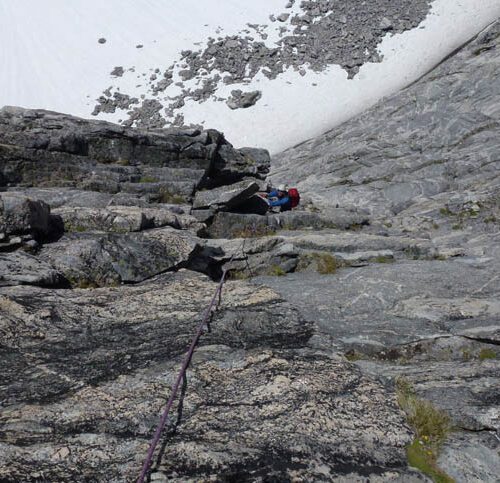
P1. Scramble up to a small overhang providing access to a left trending ramp/crack system. Climb this, passing 1 bolt and 1 fix piton, to the base a large “V” shaped slot and a 2 bolt anchor. 5.9, 45m
P2. Climb the vertical arête defining the right edge of the “V” slot (crux) to a featured slab and easier ground passing 4 bolts to a 2 bolt belay in and open dish. 5.10d, 25m
P3. Climb up and trend right, passing a fix piton and a few loose block, towards and obvious left facing corner about 30m from the belay. Climb the corner (5.10a) and continue up and right along a ramp
system to where it is possible to easily climb back left to a good ledge with a 2 bolt belay. A wandering pitch with possible rope drag. 5.10a, 55m
P4. Climb the right-hand crack above the belay for a few meters then step left across a ledge a few meters. Climb a vertical crack leading to a long left leaning corner caped by a roof. Climb this beautiful
corner to a small sloping stance about 30m from the top of pitch 3 and belay on good gear. 5.9, 30m
P5. Continue along the steepening corner toward the roof passing an insecure lay-back section (5.11a). Look for a few key camalot #1 and #2 placements in odd triangular crack pockets on the right wall just
before the crux lay-back. Continue more easily towards the intimidating roof. Climb the left side of the roof then traverses back right wildly along an exposed sloping ledge to a 2 bolt belay. 5.11a, 25m. Note:
it is possible to combined P4 and P5 but the rope drag and gear management can be limiting factors.
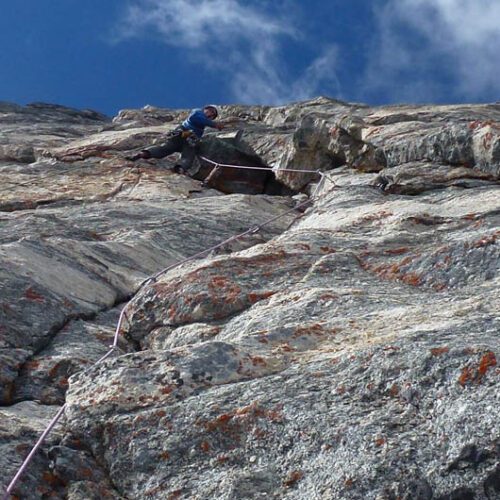
P6. Climb up and left via a thin lay-back seam past 2 bolts. Continue up and right over a steep flake passing one fix piton. Beware of a precarious looking flake above the piton, it is avoidable. Continue up
and right via an steepening arch passing 2 more bolts (5.11b). After the arch climb up and back left passing another bolt then skirt around the left side of an overhang, passing some wild chicken heads, to
a small stance with a 2 bolt belay. 5.11b, 30m
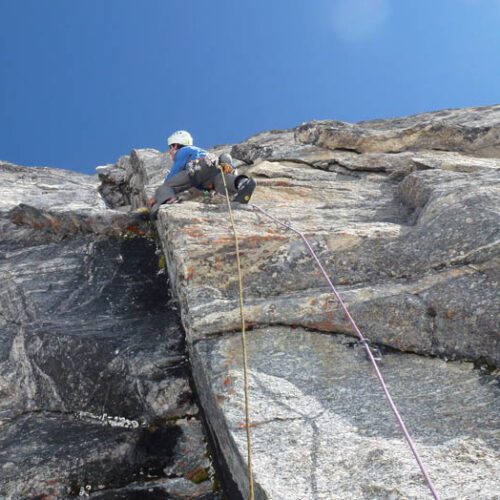
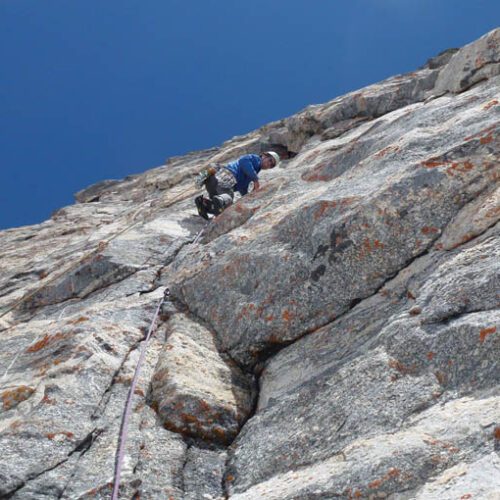
P7. A few exposed slabby moves to the right past one bolt lead to a thin arching crack caped by a small roof. Exciting the roof through the left side on good gear provides the crux of the whole route (5.11c).
Continue straight up with some insecure lay-backing along a left facing corner. The angle of the wall eventually ease and a right facing corner provide access to the east ridge and a two bolts belay. 5.11c, 30m
From the top of P7 scramble up in a Westerly direction along the East ridge to the summit, 3rd class, 60m
Gear required
1 set of cams from #0 Metolius to #3 Camalot, a second set of cam from #1 Metolius to #2 Camalot, 1 set of nuts, 2 X 60m ropes
Descent
The route can be descended in 4 long rappels, see topo. It is also possible to descend via the regular East
slope descent (3rd class).
Enjoy the photos…